


An SEO virtual assistant is the person founders hire when the weekly SEO checklist keeps slipping: someone to pull the keyword data, check Search Console every Monday, fix the titles and chase a few links. It is a sensible hire. It is also a job that has changed more in the last year than almost any other in SEO, because most of that checklist is now work software does every day.
I build RankBuddy, an AI SEO agent that does a big part of this job, so I have an obvious bias. To keep this useful anyway, I split the SEO VA role into its actual tasks, checked what VAs cost in 2026 from the rates agencies publish, and marked honestly which tasks still need a person. Where RankBuddy does not do something, I say so.
Quick answer:
- What an SEO VA does: keyword research, weekly ranking and traffic reports, technical checks, competitor monitoring, content briefs, on-page edits in your CMS and link building outreach, usually 10 to 40 hours a week.
- What it costs: $5 to $13 an hour for a freelance VA in the Philippines, $25 to $50 an hour in the US, or $88 to $143 a week through a managed service. Plus the SEO tools they log into.
- What AI already does: the research, monitoring and reporting half of the job, and first drafts of content.
- What still needs a person: link building outreach, edits inside your CMS, and anything that involves talking to clients.
What an SEO virtual assistant does
Strip away the job ads and an SEO VA does the repeatable part of SEO from a checklist someone else wrote. The usual list:
- Keyword research. Pull ideas, volumes and difficulty from Semrush, Ahrefs or Google Keyword Planner and put them in a sheet.
- Weekly reporting. Copy clicks, impressions and positions from Search Console and Google Analytics into a report every Monday.
- Technical checks. Run a crawler, list broken links, redirect chains, missing tags and indexing problems.
- Competitor monitoring. Check what competitors published and which keywords they gained.
- Content support. Write briefs, brief writers, sometimes write the articles.
- On-page work. Update titles, meta descriptions, headings and internal links in the CMS.
- Link building. Find sites, write outreach emails, follow up, track the links.
- Admin. Calls, updates to clients or the founder, and the odd non-SEO task that lands on them.
The first five are research and monitoring. The last three are doing things in the world: changing a website, emailing a stranger, talking to a client. That split decides almost everything below.
What an SEO virtual assistant costs in 2026
These are published rates from VA agencies and managed SEO VA services, checked in October 2026. They move with experience and contract length.
| Option | Price | What to know |
|---|---|---|
| Freelance SEO VA, Philippines | $5 to $13 an hour | At $9 an hour and 20 to 30 hours a week, about $780 to $1,170 a month |
| Remote SEO VA, United States | $25 to $50 an hour | More experience, your time zone |
| Managed SEO VA service | $88 to $143 a week | The agency recruits and replaces |
| Dedicated SEO specialist via an agency | $699 to $799 a month | Full-time, usually offshore |
| US marketing agency doing the same work | $75 to $200 an hour | For comparison |
Three costs rarely show up in those numbers:
- The tools. A VA does keyword research with your Semrush or Ahrefs login. Semrush One Starter is $199 a month and Ahrefs Lite is $129, so the tool bill can be a fifth to a quarter of the VA's pay.
- Onboarding. Managed services quote about 15 business days to place someone, and then the VA still has to learn your site and your checklist.
- Your time. Someone has to write the checklist, review the work and decide what matters. A VA executes; they rarely set the strategy.
Which SEO VA tasks AI already does
Here is the same task list, with what RankBuddy does for each. "Finds it, you act" means it does the research and writes down the exact change, and a person makes it.
| Task | A human SEO VA | RankBuddy | Verdict |
|---|---|---|---|
| Keyword research | Pulls ideas from the tools you pay for | Volumes, difficulty and intent from DataForSEO, plus Google's current top 10 for each idea, included in the plan | Does it |
| Weekly traffic and rankings report | Copies Search Console into a sheet every Monday | Reads your Search Console on a schedule and writes up what moved, what slipped and what to do next | Does it |
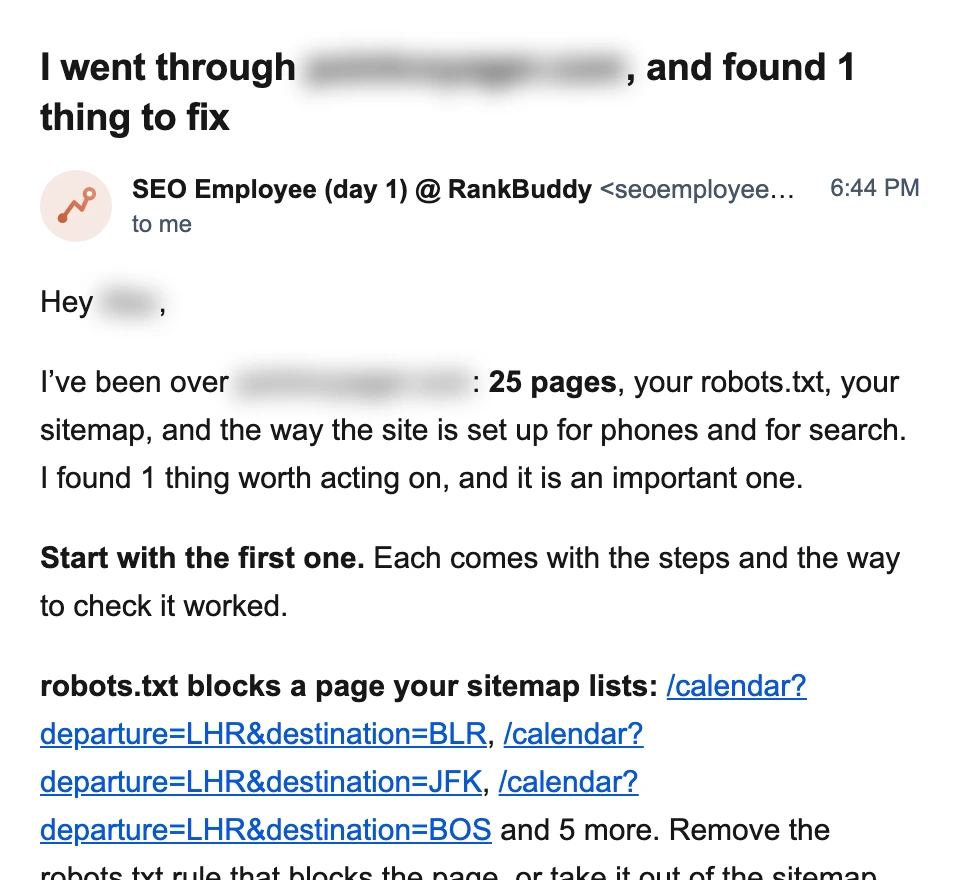
| Technical checks | Runs a crawler and sends a list | Checks indexing, redirects, robots.txt, canonicals and Core Web Vitals on the pages that matter, ordered by what costs you traffic | Does it |
| Competitor monitoring | Looks when there is time | Finds searches your competitors rank for and you have no page for | Does it |
| Content briefs and articles | Writes or briefs a writer | Drafts researched articles against your site; nothing goes live until you approve it, and Webflow publishing is built in | Does it |
| On-page fixes and internal links | Edits your CMS | Gives the exact title, meta description and links to add, with anchor text | Finds it, you act |
| Link building outreach | Finds sites, writes and follows up | Shows your backlink gap against competitors, sends no emails | Finds it, you act |
| Admin and client calls | Yes | No, it is software | Person only |
What this looks like in practice: the agent sends its findings as emails, the way a VA would. These are real letters it sent to a customer's site in its first days, with the site's name blurred.
On day two the same site got this one, about a search its competitors rank for and it had no page for:
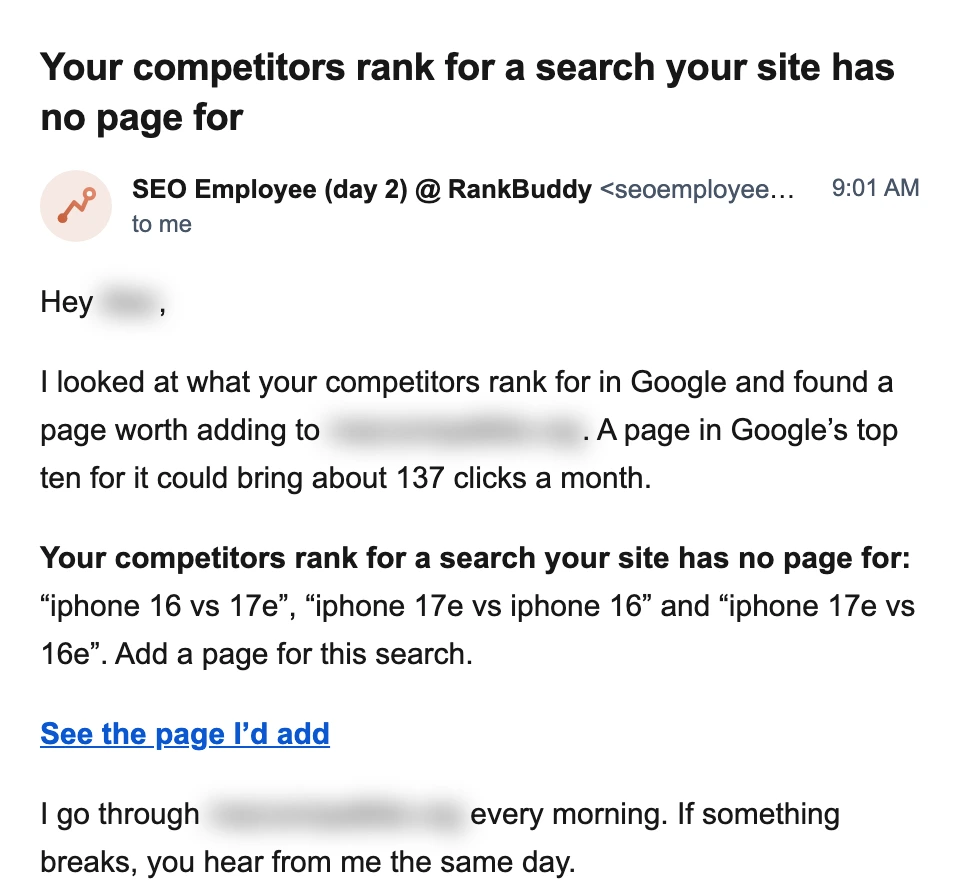
That is the research half of a VA's week, delivered without being asked. What it does not do is open the CMS and fix the robots.txt rule itself.
Where a human SEO VA is still the better choice
I would still hire a person in these cases:
- You need link building. Outreach is relationships, follow-ups and judgement about which sites are worth it. Software can find the gap; a person has to close it.
- Someone has to change the site, and you will not. RankBuddy writes the fixes down precisely, but unless you publish through Webflow, a person still pastes the article in and edits the titles.
- You run an agency. Clients want a person on the call and a name on the report.
- Your site is not on a platform anyone can read. Very custom setups, sites behind logins, or work that is mostly in tools other than Google.
A VA, an AI agent, or both: cost side by side
For a small business site, a realistic comparison looks like this:
| Setup | Monthly cost | Who does what |
|---|---|---|
| Philippines VA, 20 hours a week, plus Semrush One Starter | About $780 + $199 = $979 | The VA does everything on the checklist, you review |
| RankBuddy alone | $29, $49 or $79 (100, 200 or 400 credits) | The agent researches, monitors, reports and drafts; you make the edits and approve articles |
| RankBuddy plus a VA for 5 hours a week | About $29 + $195 = $224 | The agent finds the work, the VA does the edits and outreach |
These are not equal outputs. A VA can send outreach emails and change your site; RankBuddy cannot. But the research and reporting hours are the expensive part of a VA's week, and they are the part software now does every day.
The setup I would pick
- Solo founder, no budget for a hire: start with an AI agent for the research and reporting, and make the edits yourself. Doing the changes takes far less time than doing the research and the reporting as well.
- Small team that already has a VA: keep the VA, but move their hours from research to doing. Give them the agent's findings as their to-do list.
- You need links: hire a person for outreach. Nothing automated does that well, and the automated versions tend to look like spam.
- Agency: use an agent for the research and the weekly reports across clients, and keep people for client work and implementation.
If you hire an SEO VA: what to check
If a person is the right call, a few things save a bad hire:
- Give a paid test task. For example: "Here is our Search Console. Which five pages lost the most clicks this month, and why?" You learn more from that than from a portfolio.
- Ask which tools they need. If the answer is "Semrush and Ahrefs", add those to the cost.
- Agree on the weekly report format before they start, so Monday's report answers your questions.
- Watch for link promises. "100 backlinks a month" usually means directories and paid links that can hurt you.
- Keep the strategy with you. A VA executes a checklist well. Deciding what is on it is still your job, or a tool's.
For the bigger picture of where AI fits next to consultants and agencies, I compared the options in AI SEO expert: consultant, agency or AI, and explained how an agent differs from a chatbot in AI agent for SEO. If reporting is the part you want off your plate first, see automated SEO reports. And if you would rather ask your questions in ChatGPT or Claude, my guide to SEO chat tools covers that route. RankBuddy's plans are on the pricing page.